Your Jaw Is Clenched Right Now: The Quiet Case for a Softer Body
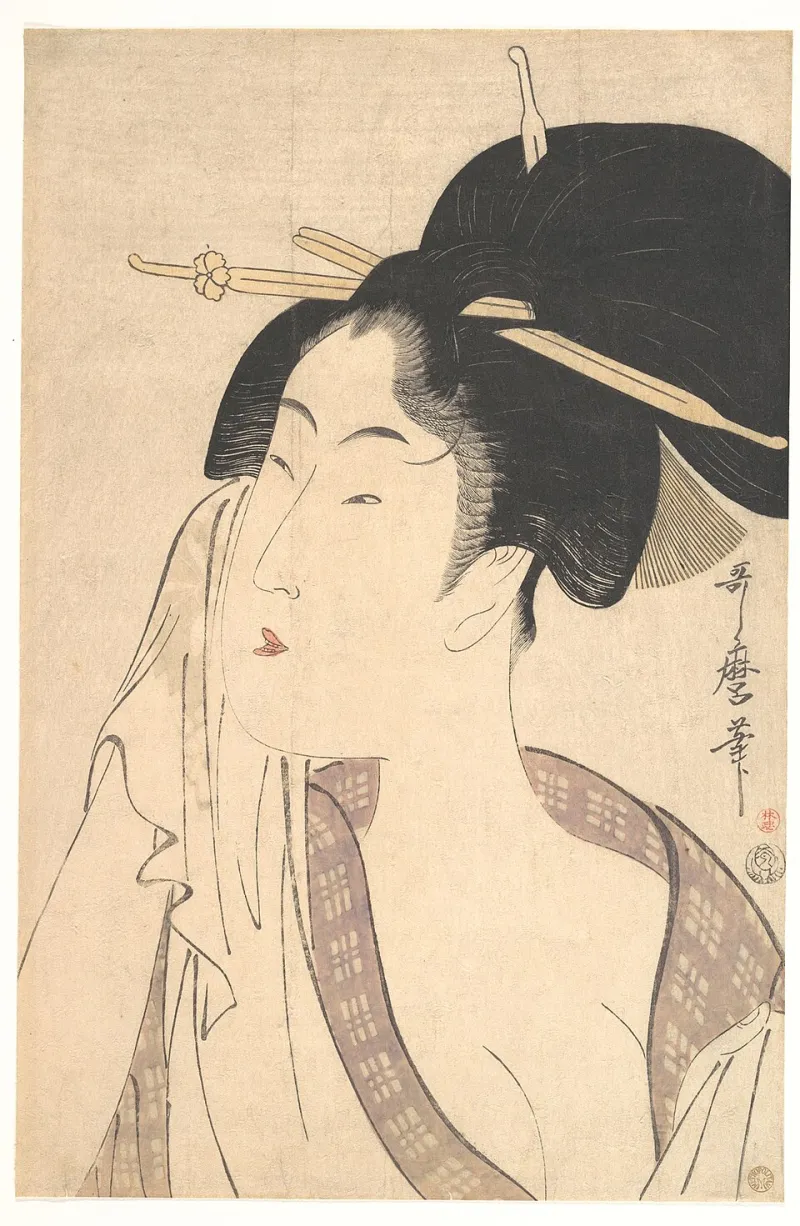
Photo: Kitagawa Utamaro, Public domain, via Wikimedia Commons
Try something for me. Notice your jaw. Really notice it. Is it clenched? Are your teeth touching? Are your shoulders sitting somewhere up around your ears?
If you just felt a small wave of release as you read that — welcome. That little moment is what this whole article is about.
Somewhere in the last decade or two, our bodies became part of the job description. We learned to "look engaged" on video calls, to smile at customers and cameras and colleagues, to hold ourselves in a state of alert readiness from the morning alarm to the moment we finally collapse into the couch. Even our resting faces got drafted. Even our posture is on the clock.
And honestly? That's exhausting in a way we rarely name, because it doesn't show up on any to-do list.
The Face You Make When Nobody's Watching
There's a particular kind of tiredness that comes from performing ease. You know the one — the pleasant, slightly-attentive expression you wear in meetings, the eyebrows raised just enough to signal interest, the mouth curved into what I've heard called the "Zoom smile." You're not saying anything. You're not even thinking anything particularly effortful. But your face is working.
Then the meeting ends, and the expression... stays. You carry it into the kitchen. Into the carpool line. Into the scroll of your evening, where your brows furrow at a stranger's opinion and your shoulders hunch toward a screen like it might bolt.
Here's the thing nobody told us: the body doesn't know the difference between performing alertness and being in actual danger. Hold your shoulders tense for eight hours and your nervous system reads that as a message: something is still happening. Stay ready. No wonder we arrive at bedtime wired.
Softness Is Not Slacking
I want to be clear about what this isn't. Letting your body rest isn't laziness, and it isn't a productivity hack in disguise — I'm not going to promise it'll make you sharper or more efficient, because that would just be selling you the same hustle with a lavender candle next to it.
This is permission. Plain and simple.
Permission to let your face be neutral. Permission to let your shoulders live somewhere below your earlobes. Permission to let your gaze soften and land on nothing in particular — the way you did as a kid lying on the carpet, watching dust drift through a sunbeam, entirely unimpressive and entirely at peace.
Call it a resting face. Call it a resting body. The phrase that keeps coming to me is standing down — that military term for when the alert is over and everyone gets to breathe again. Most of us never stood down. We just learned to be quietly, constantly at attention.
A Few Moments of Letting Go
You don't need a practice, a cushion, or an app for this. What follows are just small pauses — little checkpoints you can scatter through a regular American Tuesday. No one around you will notice a thing.
The jaw check. Whenever you pass through a doorway today — your front door, the office entrance, the gas station — let your teeth part slightly and your tongue rest low in your mouth. Doorways are everywhere. Free reminders, built into the architecture.
The shoulder drop. At a red light, in line at the pharmacy, waiting for the microwave: inhale, lift your shoulders up toward your ears, then let them fall with the exhale. Don't position them. Just let them drop. They'll find their own place.
The soft gaze. Once a day, look at something more than twenty feet away — a tree out the window, the far wall of the grocery store — and let your eyes unfocus. No scanning, no reading, no assessing. Just looking, the way water looks at a lake.
The hands. Curling fingers, white-knuckled grips, thumbs hovering over a phone. Open your palms and rest them somewhere — your lap, the table, the steering wheel at a gentle angle. Hands that have nothing to hold for thirty seconds.
The exhale you didn't take. Most of us end breaths halfway and start the next one. Once in a while, finish the exhale all the way out, like a sigh you're finally letting yourself have.
None of these are techniques to master. They're just moments where you stop holding yourself up like a performance review is happening.
What Happens When You Stop Performing
Here's what I've noticed, slowly, since I started doing this: the world doesn't end. Nobody in the Target checkout line cares that my face is neutral. The meeting proceeds fine when my eyebrows aren't doing overtime. And somewhere underneath all that held tension, there's a person who is — surprise — actually tired, and actually fine, and doesn't need to look like anything.
There's a deeper shift too. When your body stops broadcasting ready, your mind starts to believe it. Shoulders down, jaw loose, gaze soft — and suddenly the notification on your phone feels less like an emergency. The email can wait. The evening can be quiet. You can be a person instead of a presence.
So here's your permission slip, in writing: you are allowed to look tired. You are allowed to look bored. You are allowed to look like absolutely nothing at all.
Your face was never meant to be a job. Neither were your shoulders, or your hands, or the set of your mouth. Let them off duty for a minute. They've been holding the whole thing up longer than you realize — and they'd really like to sit down.